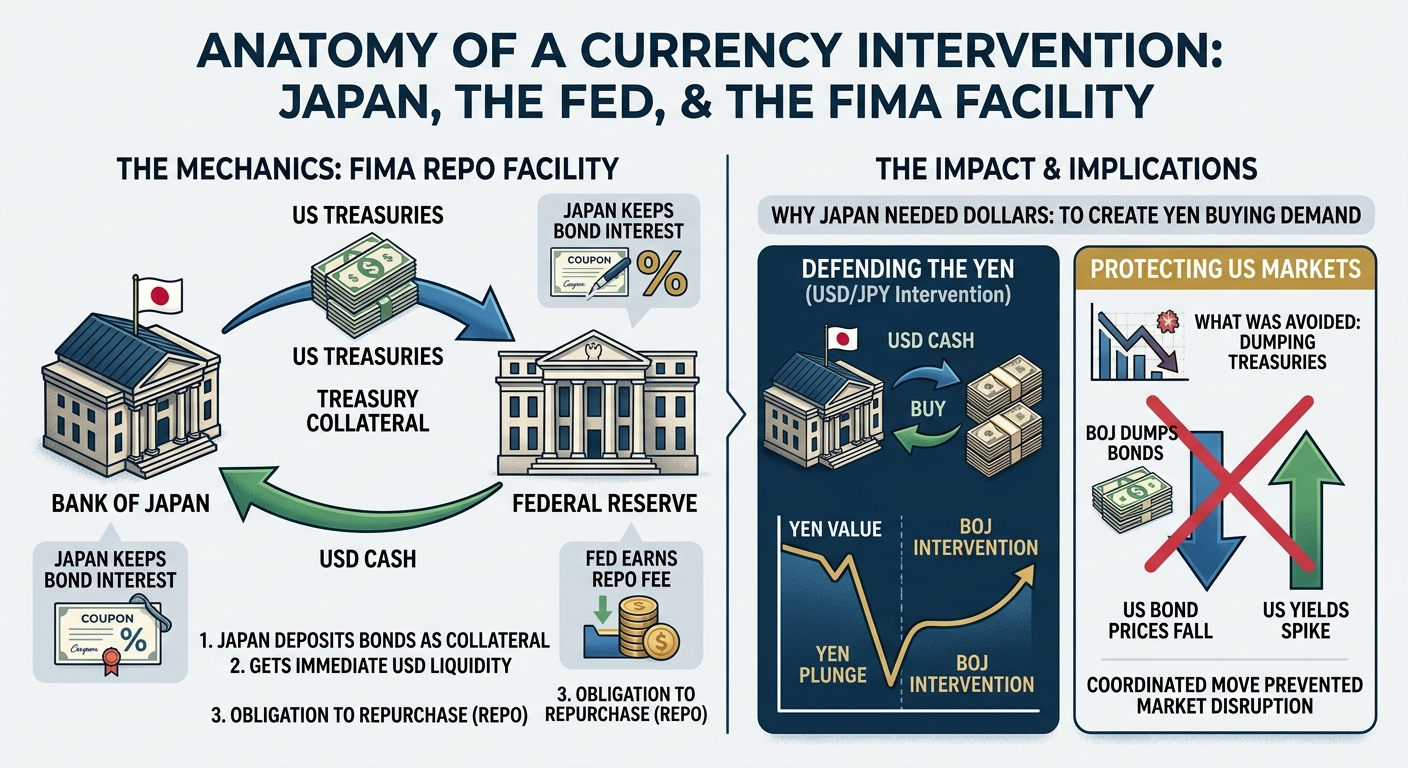
In mid-2026, the Japanese yen careened to multi-decade lows against the US dollar. Faced with a rapidly depreciating currency, Japan’s Ministry of Finance needed billions of dollars—and fast—to execute a massive foreign exchange intervention.
Normally, a foreign government defending its currency would just liquidate a portion of its foreign reserves. For Japan, which holds over $1.1 trillion in US Treasuries, the standard playbook would be to dump billions of dollars of those bonds onto the open market. But doing so in 2026 threatened to trigger a catastrophic chain reaction for the US economy.
Enter the Federal Reserve’s "inside" fix. By utilizing a little-known financial bazooka, Japan executed its yen rescue without crashing the US bond market—and actually ended up paying the Federal Reserve for the privilege.
Here is a deep dive into the mechanics, the money, and the hidden global plumbing that made it all work.
Why Japan Needed US Dollars to Save the Yen
To understand the trade, you first have to understand the crisis. You cannot buy yen using yen.
When a currency collapses, a central bank must create massive buying demand on the open market. To buy trillions of yen and retire them from circulation, Japan had to pay sellers with an asset they actually wanted: US dollars.
The yen’s historic weakness was heavily driven by the Yen Carry Trade. For years, global investors borrowed cheap yen at near-zero Japanese interest rates, converted those funds into US dollars, and invested in higher-yielding US assets. To penalize these short sellers and force a sharp reversal, Japan had to dump tens of billions of real dollars into the foreign exchange market, driving the dollar down and forcing the yen up.
The Problem: The Threat of a Bond Market Fire Sale
Japan had the reserves to fight this battle, but those reserves are held in US government debt, not cash.
If Japan suddenly flooded the open, secondary market with $50 billion to $100 billion in US Treasury bonds, it would drive bond prices into the ground. Because bond prices and yields are inversely correlated, falling Treasury prices automatically drive US Treasury yields up.
Higher Treasury yields dictate borrowing costs across the entire American economy. A sudden spike would mean higher US mortgage rates, more expensive corporate loans, and a massive increase in the cost of refinancing the US national debt.
The Solution: The FIMA Repo Facility
To prevent this collateral damage, the US and Japan turned to the Federal Reserve’s FIMA (Foreign and International Monetary Authorities) Repo Facility. Originally established as an emergency backstop during the 2020 market crash and made permanent in 2021, FIMA rewrites the architecture of global dollar funding.
Instead of permanently selling off its bonds, Japan used FIMA to execute a Repurchase Agreement (Repo).
1. The Pledge: Japan temporarily deposits its US Treasuries at the New York Fed as collateral. 2. The Cash: The Fed instantly loans Japan US dollars against that collateral (up to $60 billion per day). 3. The Action: Japan uses those newly printed dollars to buy yen on the open market. 4. The Repayment: At the end of the short-term contract (usually overnight or 7 days), Japan is legally obligated to return the borrowed dollars to the Fed, plus interest, to reclaim its bonds.
Who Pays Who? The Interest Rate Puzzle
At first glance, it might seem like the US is losing out. After all, Japan is still getting paid interest on bonds that it effectively pawned to the Fed. But analyzing the balance sheets reveals a different reality.
1. The US Treasury (The baseline obligation)
The US Treasury issued Japan’s bonds years ago to fund the federal budget. By law, the Treasury must pay the fixed coupon (interest) to the owner until the bond matures. Whether Japan keeps the bonds in a vault in Tokyo or pledges them to the Fed, the US Treasury pays the exact same amount. There is zero additional cost to the US taxpayer.
2. The Federal Reserve (The net new revenue)
Because a repo is a collateralized loan, Japan retains ownership of the bonds and continues to collect that Treasury coupon. However, Japan must pay the Fed an interest rate to borrow the cash. The Fed deliberately prices FIMA above private market rates (the standing repo rate plus a penalty spread) so it functions strictly as a backstop.
If we consolidate the US government (Treasury \+ Fed), the math looks like this:
![][image1]Because the Treasury owed the coupon regardless, the repo fee is net new revenue paid directly by the Bank of Japan to the Federal Reserve.
3. Japan's "Negative Carry"
Japan is actually taking a financial haircut to do this. Because Japan accumulated its $1+ trillion reserve over the past decade, many of its bonds have older, lower yields (e.g., 1.5% to 2.5%). Meanwhile, borrowing cash from the Fed in today’s higher-rate environment costs them upwards of 3.75% or more. Japan willingly swallows this "negative carry" because its goal is national economic defense, not arbitrage profit.
A Masterclass in Global Financial Plumbing
The use of the FIMA facility is a win-win for both nations that perfectly illustrates the hidden mechanics of global finance:
- For Japan: It gains up to $60 billion in instant, guaranteed daily liquidity without having to find private buyers. Crucially, it avoids locking in massive capital losses that would result from selling older, lower-yielding bonds at today's discounted market prices.
- For the United States: The Federal Reserve absorbs the bond supply temporarily, entirely shielding the domestic bond market from a supply glut. Mortgage rates stay stable, borrowing costs are protected, and the Fed collects a premium borrowing fee from a foreign government.
What could have been a messy, market-crashing liquidation was instead handled quietly in the background—a testament to how interconnected and cooperative global central banking has become.